Search
Clear search
Close search
Main menu
Google apps
Google Account
Akshay S Dinesh
asdofindia@gmail.com

Caste and mfc

22 views

rakhal.gaitonde

8 Mar 2022, 12:51:4108/03/2022
to Mfccircle
In the last at least 5 years, there have been at least 4-5 calls for a discussion and / or systematic review of caste and mfc, and especially for an institutional analysis of mfc vis-a-vis caste. Despite some specific initiatives and ideas being discussed briefly and people volunteering to work on this, what marked all these initiatives consistently was that they were non-starters. In other words we as a group and thought current have resolutely refused to engage with the issue of caste. It seems either that as a group / collective we are either refusing to engage with it or do not have the imagination on how we may address it. Either way what this reveals is disturbing. Of course many of us individually may be part of various anti-caste initiatives and even try and bring in anti-caste initiatives in our own organizations - but that is different in my opinion about mfc as a space and its inclusive or exclusive nature. This refusal to engage with caste I believe is a failure of mfc and to me reveals its collective casteist nature.

I would suggest that instead of struggling with the question of whether we are casetist - for which I think the resounding answer is there "blowin in the wind" - yes we are, we would be more productive by tackling the issue of what we are going to do about it. In this connection I have three specific suggestions (some of which have been suggested by others in the past).

- The first is to engage with ways institutions are and can be casteist. For this we may take the help of Amita Pitre and her group of friends who worked on the fanstatic  report on institutional casteism as revealed in the Payal Tadavi case. We may ask ourselves the quesiton - how does the functioning of mfc - effectively exclude dalit / bahujan / adivasi voices. I would like to add here that in my opinion it is not (only) about the caste (and gender) composition of convenors and members - but more importantly about what Gopal Guru calls the schism between "theoretical brahmins and empiric shudras". In other words I am wondering about the exclusive nature of our very constitution as a "thought current". Even as we do share personal journeys etc., and there is a lot of reflection on what we as individuals have "done" - the question marginalized groups always pose to dominant spaces is whether they find their experience reflected in our discussions - and if they do not then we are excluding them.
- Can we map out Ambedkarite, Phuleite, Periyarist and Adivasi scholars who have worked on health and arrange a session for us to listen to them? By listening to them articulate their view on health I am sure useful spaces and points for engagement, learning and sharing will emerge.
- Can we actively invite friends and fellow travellers for dalit / bahujan / adivasi backgrounds to attend meetings in larger numbers and assure and create spaces that are more inlcusive (of course we need to learn how)?

I do hope that we can collectively overcome the casteist nature of mfc as a space. I look forward to discussion on this and suggestions on ways forward.

sincerely,

rakhal

alamel10

8 Mar 2022, 19:24:5008/03/2022
to Mfccircle, rakhal.gaitonde
Rakhal,

It would be presumptuous for me to enter this discussion, since I'm on the periphery and do not live there. However, I do want to say you are making excellent suggestions. I do hope your recommendations will be taken up, because there is much I have to learn. I rejected "caste" in my youth, but I ignored it and that does not extinguish it in reality. I find now I have been ignorant of the many ways in which it is manifested and may have unwittingly accepted or endorsed it. Thank you.

Nalini

--
You received this message because you are subscribed to the Google Groups "mfccircle" group.
To unsubscribe from this group and stop receiving emails from it, send an email to mfccircle+...@googlegroups.com.
To view this discussion on the web visit https://groups.google.com/d/msgid/mfccircle/CALb95YQvUJ9Y9ebxfbj_cpSvehiHaPrp3WHYpfxiL%3DirA%3DsM9A%40mail.gmail.com.

priyadarshture

8 Mar 2022, 19:29:2108/03/2022
to alamel10, Mfccircle, rakhal.gaitonde
It is very much relevant issues . 

Recently Yumetta and friends had decided to work on Institutional Discrimination and it's effect on mental health of youths in higher education institutes.

We are talking to many youths and senior members And the stories we are hearing after meeting many people are concerning. 

I am in for any work in this issues in Thoughts , discussion and also action.

Regards. 

Priyadarsh

sunil

8 Mar 2022, 23:49:2608/03/2022
to priyadarshture, alamel10, Mfccircle, rakhal.gaitonde
Thanks Rakhal for raising the point yet again. 

And.... Can the EC just authorise one or more of the suggestions put forward by Rakhal?

Sunil


Anant Bhan

9 Mar 2022, 12:33:4509/03/2022
to priyadarshture, sunil, alamel10, Mfccircle, rakhal.gaitonde
Thanks Rakhal for bringing this up, 

I remember asking (and others too) specifically for a couple of things-- an analysis of how many convenors and EC members since mfc started have been from priviliged castes Vs those from backgrounds which have been historically discriminated against and under-represented. As part of our own reflection on how casteist we are structurally, this should be in my mind something doable. It was never taken up. Can I request the present EC to do this, in addition to the points Rakhal has made?

Best,
Anant

snandraj

9 Mar 2022, 13:03:4509/03/2022
to Anant Bhan, priyadarshture, sunil, alamel10, Mfccircle, rakhal.gaitonde
FYI Anant 

From: Sunil <snan...@gmail.com>
Date: 14 April 2021 at 2:46:15 PM IST
To: eGroup MFC <mfcc...@googlegroups.com>
Subject: Medico Friends Circle (MFC) Conveners - Through the times…….


Dear Friends,

I have enjoyed reading the debates, discussions and exchanges that have taken place on the MFC e-forum on gender, caste, allopathy vs other systems of medicine, public health leadership, personality dominated organisations, second line of leadership, providing space for youngsters, minorities among other issues. I have often wondered and shared these with friends on how these issues echoed or have reflected in different organisations, institutions, NGOs, civil society and activists’ groups, etc. In this context, I undertook a small inquiry with regard to the conveners through the times in the MFC. (source: http://www.mfcindia.org/main/MFC_40_years.pdf). MFC began in 1974, for more information on its perceptive, history, activities, organisation structure, bulletin etc. click http://www.mfcindia.org 

It is one of the best organisations that I have been fortunate and proud to be associated. It has not been in the limelight nor does it self-promote its activities or individuals are encouraged to promote themselves. However, it has been at the forefront and has spurned many initiatives and organisations to take up issues, causes or areas of work. If one traces many of the issues being discussed, the credit goes to the discussions and debates that took place in MFC meets and in the bulletins. It has taken up themes for discussion which were farsighted, non-mainstream, and when no one thought they were important.  It provided a platform for critical and alternative thinking.

MFC’s convenors are chosen from among the members and serve for a term of two years.  Convenor-ship of MFC is not a post for which elections are held with members contending for the post or something that members are dying to become conveners. Mostly some of the members have to be requested, persuaded, sweet — talked, cajoled, prevail on their love for the organisation among other methods of persuasion to take up the convenor-ship  Usually, the post of the convener is a thankless one and the conveners over the years have carried out the tasks and responsibilities in spite of their busy or their regular commitments. Those members who have been consistently active in MFC and are prepared to give time and energy for its organisational growth have constituted the so called 'core-group'. The 'core-group' consisting of twenty to thirty friends at any given time is informal and newcomers are encouraged to join it. The convener is supported by an Executive Committee which is voluntary and chosen/nominated from among the members.

Over the years, there have been 36 conveners (including joint convenors). There were 14 conveners who shouldered the responsibility single handedly and 22 were joint conveners (2 or more). The trend of joint conveners started from 2007 and has continued presently. Only the first convener was for 5 years and another one for 3 years. We had the first woman convener only in 1992 (18 years after MFC started) and out of 36, 11 (30%) were women.  A large portion of conveners came from Maharashtra 9, followed by 6 from Delhi, there were 4 each from Chhattisgarh and Assam, 3 from Tamil Nadu, 2 each from Gujarat, Madhya Pradesh, Andhra Pradesh and 1 each from Karnataka and Rajasthan, in 2 can’t make out the place. When there were joint conveners, they usually were from one place. Half of the conveners were from rural areas. 67% of the conveners were above 40 years of age when they became conveners. In terms of religion and caste majority of them do not believe or give importance to religion or caste, however, have looked at the religion and caste based on the names. Of the 36 conveners 6 were Christians, 1 Sikh, 1 Muslim and the rest 28 were Hindus. From among the 28 Hindus, 26 were from upper caste and one was from schedule caste and one from the schedule tribe. Of the 36 conveners 24 (67%) were Doctors from modern medicine.  There were no doctors from other systems of medicine, nurses, dentists or from the para medical field as conveners. Out of the other 12, most of them were from the Social Sciences.

I am sure there would be various viewpoints, opinions on the above analysis, would welcome them. I do hope that this would make us reflect and undertake research on similar lines of the organisations we work and associate. Further, it would be of interest to study when and what themes were taken up for the MFC annual meets, where they were held among other aspects as part of documenting the history of MFC.

Cheers

Sunil Nandraj


On 09-Mar-2022, at 12:33 PM, 'Anant Bhan' via mfccircle <mfcc...@googlegroups.com> wrote:


akhila.punch

9 Mar 2022, 21:45:4809/03/2022
to sunil, priyadarshture, alamel10, Mfccircle, rakhal.gaitonde

Speaking as a privileged savarna brahmin woman... And as a fringe member who enjoys and learns from the discussions here

Personally I find the mfc space 🙈... Unnerving...  Forbidding even... I feel any space that calls itself a "thinking space" Is defining itself in brahminical terms. 

This discussion of caste reminds me of something that happened in JAAk 10 years ago. Some of us felt we had to call out certain brahminical practices in JAAk and we did. But we were accused of 'playing the 'caste card'. I am just wondering what would have been the response had someone outside of mfc had characterised it as casteist. 

One other concern that has been on my mind-  I had proposed my colleague Vijay's name as an mfc member. It was seconded by two people. But for some reason (it could be that my email was buried beneath many others and did not catch the convenors' attention) he was not added to the e-group for several days. I wrote an email to one of the convenors to check if there was any specific reason. Vijay was eventually added... 

I still don't know what happened... Was it just oversight or was there some serious concern. If it was the latter wouldn't it have been better to indicate that directly to whoever proposed and seconded. If it was the former just a line of clarification would have helped. This episode left me wondering whether mfc was some exclusive club where some people more worthy than others.... 

My two pence worth: in addition to caste composition of mfc convenors and members it may be good to review processes also... Also explore whether there were people who were not accepted as members, who were they and why were they excluded. 

sairam1179

9 Mar 2022, 23:22:3509/03/2022
to akhila.punch, sunil, priyadarshture, alamel10, Mfccircle, rakhal.gaitonde
Dear Rakhal,

I think all of your suggestions are very valuable and need to be acted upon. Hopefully by the coming mid annual meet, MFC can return to a physical meet format. In the meantime, we can discuss and plan on implementing these suggestions and also working on the larger theme of institutional discrimination against persons of marginalized communities which was one of the themes decided at the pre pandemic annual meeting at sewagram. Perhaps we could have a dedicated discussion on these suggestions in the upcoming annual meet, and plan further action. 

Regards
Savithri 

sairam1179

9 Mar 2022, 23:26:0209/03/2022
to akhila.punch, sunil, priyadarshture, alamel10, Mfccircle, rakhal.gaitonde
Dear Akhila,

I apologize for the delay in adding Vijayakumar to the e group. I assure you that it was only a procedural delay owing to some other pre occupations on our part and we had no other concern of any sort. In fact I have to admit that we are guilty of a few such delays especially the past year. 

Regards 
Savithri
On behalf of MFC convenors 2020-22

On Wed, 9 Mar 2022, 21:45 Akhila Vasan, <akhila...@gmail.com> wrote:

drghosh85

10 Mar 2022, 05:26:0010/03/2022
to sairam1179, akhila.punch, sunil, priyadarshture, alamel10, Mfccircle, rakhal.gaitonde, prab...@yahoo.com
Dear friends, 

1) This is an intriguing topic which should be discussed on a regular basis. In my personal opinion, MFC have that enabling environment to ask, to protest and to express doubt. MFC welcomes the voice of dissents too. Probably a discussion hesitancy  (where/how/when to start) is there. My humble submission would be to create  a separate session where anybody may join and express their opinions. We may encourage each member to share their reviews /feedbacks/suggestions with or without disclosing identity (both should be accepted). We may also consider qualitative aspects ( scope and expectations - representations of privileged vs non privileged, listening of unheard voices, feeling/reason for the exclusion/seclusion, way forward etc). I also feel that this exercise should not be turned into blame game and must not be disrespectful to our seniors as they toiled away many hardships in establishing this platform.

Defining the boundaries of casteism is a difficult task ; at times perceptions rule the roost. I am sharing my experience. While creating a manual for Early Childhood Care and Education for one ground level organization, I made one graphiti which depicting a lady is cooking in a metal pan with the fire and wood over clay oven at the time of sunset in a village setting (space and air) to explain the elements of Nature. (First part was the story telling, next was seeing the graphiti and the last was playing activities). Somebody tagged this graphiti as a casteist due to the elements of Nature. Honestly I never thought that this could be seen as casteist to someone. Elements of Nature exists throughout the various civilizations. After listening that we discussed and argued about that but I removed that part to unhurt any sentiment. The question that still haunts me, 'Why be the learning the elements of Nature tagged as casteist?'. Should we see everything from the angle of Vedic vs. Non Vedic practices , Western vs. Indian practices? Is advising to practice Surya Namaskar or Yoga Casteist? 

2) Members from other disciplines(AYUSH/Dentists/Public Health) may be mainstreamed when MFC will create that space. 

N. B. : 

I belong from privileged caste. I have never seen caste related  discrimination  by my family while growing up. I saw my dad, late mom,  elder brother etc.  never hold any sense of discrimination and I learnt like that way. I have never seen my family members making enquiring through surname and so I. At present moment, our family have members from both the SC, ST and Muslim.

I also must share another incident.  I vividly remembered only one tube well was placed at my school. Everykids prefered to drink water by touching their mouths to the outlet but everybody used to clean that outlet after the drinking. Satiating unquenchable thirst at the recess was the religion and caste. That was not the age of sophisticated colorful bottles. 

I exposed more about the casteism after coming to North and Central India. So defining the casteism is not an easy task but the scope and creating space for speaking  listening, arguing must be there. Every step is a baby step. 

Sorry for writing a lengthy one. 

Cheers. 

Braj

akhila.punch

10 Mar 2022, 06:37:3710/03/2022
to sairam1179, sunil, priyadarshture, alamel10, Mfccircle, rakhal.gaitonde
Dear Savitri

Thank you for the clarification. It really helps :-) 

Best 
Akhila

Anant Bhan

10 Mar 2022, 10:27:3610/03/2022
to snandraj, priyadarshture, sunil, alamel10, Mfccircle, rakhal.gaitonde
Thanks for sharing, Sunil. 

I missed this email in April 2021, so good to see the disaggregated analysis. 

As the note shows, there are some relevant findings for reflection here

"
We had the first woman convener only in 1992 (18 years after MFC started) and out of 36, 11 (30%) were women.  A large portion of conveners came from Maharashtra 9, followed by 6 from Delhi, there were 4 each from Chhattisgarh and Assam, 3 from Tamil Nadu, 2 each from Gujarat, Madhya Pradesh, Andhra Pradesh and 1 each from Karnataka and Rajasthan, in 2 can’t make out the place. When there were joint conveners, they usually were from one place. Half of the conveners were from rural areas. 67% of the conveners were above 40 years of age when they became conveners. In terms of religion and caste majority of them do not believe or give importance to religion or caste, however, have looked at the religion and caste based on the names. Of the 36 conveners 6 were Christians, 1 Sikh, 1 Muslim and the rest 28 were Hindus. From among the 28 Hindus, 26 were from upper caste and one was from schedule caste and one from the schedule tribe. Of the 36 conveners 24 (67%) were Doctors from modern medicine.  There were no doctors from other systems of medicine, nurses, dentists or from the para medical field as conveners. Out of the other 12, most of them were from the Social Sciences."

amar.jesani

10 Mar 2022, 15:51:2410/03/2022
to eGroup MFC
Good to see that this discussion has sustained to some extent.

The MFC has discussed sensitive issues in the past. In some, despite sharp exchanges, we have succeeded in moderating discussion well. Only when the members are either in denial mode, or demand a wider evidence base for recurrent experiences of sufferers, the discussion hurts participants of both sides. The well-known event of the latter kind was long back in 1983 - the discussion on the discrimination against women in medicine/healthcare. Not enough evidence-base existed on gender inequities & discrimination/prejudices in medicine & healthcare in India at that time, but the women of the MFC and women's group invited at the Meet, had experienced them. The personal was highly political here, and thus, it triggered lots of hurt. However, from hindsight I can say very confidently that both sides benefited from that bloodletting and evolved as better informed and sensitive human beings.

We had some good introspection on religious communalism in the aftermath of babri-mosque demolition and Gujarat riots within ourselves. Post-riots the focus is more on violence, not on the everyday and structural discrimination and prejudices. So we never had an intense discussion on the routinely normalised conscious and unconscious religious prejudices in everyday life in medicine and healthcare. So in this regard too, we could never attain the type of sensitisation, prioritisation of issues and inclusivity in organisation as we have, to a certain extent, on gender issues (or to be specific on women's issue as gender is much more complex issue). For instance, we now easily / comfortably ask questions on the non-inclusion of women but not for others.

As compared, the issue of caste has always found a fleeting reference but we have not taken it up systematically for discussion, and we have not networked and invited organisations of dalits working in the field of medicine, public health and healthcare. If the MFC has attained maturity to listen to and engage with humility with their experience and learn, then it should be taken up. Of course in such an exercise there may be some sharpness of arguments and hurt - after all caste and religious communalism issues (particularly prejudices and discriminations based on them) - have dimensions of personal being political.

I think the MFC needs boldness as well as humility to get involved in the organisation of such an Annual Meet in the next few months (end of 2022 or early 2023) in a place and environment that encourages like-minded dalit health organisations to participate in the deliberation with us. The earlier we take plunge in such deliberation, the more benefits will accrue to the MFC as well as all of us.

Amar
________________________________
Amar Jesani
Independent Researcher and Teacher (Bioethics, Public Health).
Editor, Indian Journal of Medical Ethics (https://ijme.in);
Visiting Faculty: *Yenepoya (Deemed ToBe) Univ, Mangalore; *CBEC/SIUT, Karachi; *KEMRI, Nairobi. ORCID Id: https://orcid.org/0000-0001-8884-9858


--

jasho_dg2006

10 Mar 2022, 16:13:2810/03/2022
to Mfccircle
Thanks Rakhal for broaching the question once again and thanks everyone for your thoughtful responses. The conversation that Amar initiated in late January seemed to have petered out so it's great to see a growing readiness to have some debates on this. 

As with earlier discussions on gender, maybe we can move closer to understanding how the notion of 'health' is not about an unmarked human being whose existence is not affected by contours of privilege or powerlessness. 

I am also very encouraged by Savithri's suggestion that we could have an in-person meet soon and maybe look at the larger theme of institutional discrimination against persons of marginalized communities. 

Somehow, despite years of quotas/ reservations in government medical institutions that have surely produced hundreds of health workers from marginalized groups, not many have made it to MFC. What are the Ambedkarite student groups discussing on health, if at all and can MFC listen to some of those debates?

Recently have come across a group called Bahujan Economists [https://bahujanecon.org/and was really encouraged to see how it began as a peer-led effort to combat institutional discrimination. Anything like that in health related field? 

Looking forward to hearing from others,
Jashodhara

JASHODHARA DASGUPTA

Never forget those who stretch hide 
into leather
they can craft drums that bring
down palaces
(Ranjit Hoskote, 2021)


Vineeta Bal

10 Mar 2022, 17:16:4510/03/2022
to jasho_dg2006, 'jashodhara Dasgupta' via mfccircle
At the time of Mandal II, there was a strong group of dalit activists in AIIMS, Delhi. I do not know what has happened to it. But it is worth finding out some past and present members of that group for the discussion as Amar suggested and Jasodhara seconded.

amar.jesani

10 Mar 2022, 18:01:3510/03/2022
to Vineeta Bal, jasho_dg2006, 'jashodhara Dasgupta' via mfccircle
Thanks.
I think there are more groups around, including those of doctors. We can contact them if we decide to pursue the issue and intend or decide to organise a meet. Perhaps in preparation of a meet, we can organise a few webinars.
Amar

prab...@yahoo.com

10 Mar 2022, 18:06:3110/03/2022
to mfcc...@googlegroups.com


Some of us are members of Sanitation and Justice egroup.
It takes up such issues and a few are health related too and at academic level as well.
Prabir

chinusrinivasan.x

10 Mar 2022, 18:08:1910/03/2022
to mfcc...@googlegroups.com

What is this sanitation and justice grp Prabir?

Chinu

prab...@yahoo.com

10 Mar 2022, 18:42:0710/03/2022
to mfcc...@googlegroups.com
Sanitation and Justice Googlegroup-
Rosamma, Hemangi Kadlaki, Shivshankar, Mari Thekkakara are among the 45 members. Originally started to look at issues around Manual Scavenging. However it has discussed quite a bit more over the last 2 years
Prabir

amitapitre

11 Mar 2022, 15:26:5411/03/2022
to rakhal.gaitonde, Mfccircle
Thank you Rakhal for mentioning the report. It is called 'The Steady Drumbeat of Institutional Casteism' and here is a link to it. The report is an interrogation of institutional casteism in the medical education system, how all the safe guards for it have been flouted so far, how casteism is entrenched in the everyday lives of doctors and medical students, has resulted in the institutional murder of many including Dr Payal Tadvi and far reaching steps that need to be taken to recognise the casteism and then address it.  The report has been jointly prepared by Forum Against Oppression of Women, Forum for Medical Ethics Society, Medical Friend Circle and People's Union for Civil Liberties, Maharashtra. Friends who worked to make it happen were Chayanika Shah, Sandhya Gokhale, Sujata Gothoskar, Sunita Sheel Bandewar, Meena Gopal, myself and numerous other friends.

 I do hope the reports adds to the discussion.

Warm regards,

Amita

Amita Pitre

Lead Specialist, Gender Justice

Oxfam India


--

drmirashiva1978

11 Mar 2022, 16:32:5511/03/2022
to amitapitre, rakhal.gaitonde, Mfccircle
 Dear Amita , 
Thanks for sharing this . I remember you had briefed us about the back ground  and issues involved regarding Dr Payal ,and the harassment she had faced . I think it was at the MFC Meet in Baroda ,
 Several years prior to that when we were celebrating 30 years of MFC   it could be more , in Delhi , there were  specific sessions regarding  sharing of Muzaffarnagar and also on Dalit issues , representd by Paul Diwaker .and others . May be our colleagues with sharper memories may recall more details . 
 Incidentally yesterday  'Hope Behind Bars : Notes from Indian Prisons "was released  by Justice Lokur and Justice Deepak Gupta    Edited by Sanjoy Hazarika and Madhurima Dhanuka .Others may have been aware of it but for me the figure of Undertrials constituting 76% of persons in Prisons  was shocking , who have been languishing in jails as undertrials for decades ., resulting in gross overcrowding  and worsening health , hygeine , sanitation , basic food . Majority are Dalits , Andivasis and Muslims Minority  .forgotten by Society. Many were arrested for trivial violations , some  charged  on  whimsical charges and others on  false trumped up charges under increasingly stringent  laws that systematically deny bail  and violate existing  guidelines , of Jail Manuals and even basic legal aid . The fact that Medical care ,  Court hearings and provisions to meet families etc are denied  (unless payments made , ) corruption being rife , worsened during Covid .,  The mandatory prison inspections to see the conditions  were not taking place . 
If we could add our mite in preventing this situation  where justice is delayed and denied  because  society assumes that all the undertrials are "criminals " ,it would be a small step on our part , Linking up with others  who have been working on these issues . Doing our bit while it is still possible . 
Regards 
 Mira 


sanjayaadim

11 Mar 2022, 16:39:4311/03/2022
to mfcc...@googlegroups.com
The Indian Left and no rise of plebein "

The Indian Left has been most reluctant to accomodate different social identities.Diversity in leadership is grossly undermined by the left in its organizational structures.
The left had to include dalits and Adivasis only because of political reservation otherwise there are no specific steps taken for it to happen.
Rise of OBCs was not seen in left ruled states like West Bengal and Kerala.
' Rise of Plebein ' a book by Christophe Jaffrelot has documented this with data.
   In 2006 , the last government of left in west bengal , CPM had 28 members of Assembly from brahmin caste.....!
   Thus , liberals and the left are most resistant to the rise of plebein.
( Comrade D. Raja is the latest phenomenon only....! )

Sanjay Dabhade ,
Pune , 
9823529505 ,

anant.phadke

11 Mar 2022, 23:26:4411/03/2022
to sanjayaadim, mfcc...@googlegroups.com

Dear all,

Dear all,

   I also agree with Savitri about the suggestion to  work on the suggestion to take up the theme of casteism in Health care as a theme of the coming annual meet. She has suggested that 

concretely that "we can discuss and plan on implementing these suggestions and also working on the larger theme of institutional discrimination against persons of marginalized communities 

which was one of the themes decided at the pre pandemic annual meeting at sewagram. Perhaps we could have a dedicated discussion on these suggestions in the upcoming annual meet, and plan further action."  This is what Amar has also suggested. 

    The background is - along with gender and communal dimensions, Caste hierarchy, casteism is also part of health-status and of health-care and is reflected in the structure and functioning of the health services. In MFC we have not taken up this aspect for any systematic discussion. That we did not do this all these years is certainly a big deficiency which needs to be overcome, a long overdue task and an important lacunae. We should certainly start overcoming it. 

    As regards some survey about MFC itself, that has been suggested, it's method would depend upon what is the objective. Sunil Nandraj has done some exploration and he has reported the findings again in the current email trail. He found - " We had the first woman convener only in 1992 (18 years after MFC started) and out of 36, 11 (30%) were women.  A large portion of conveners came from Maharashtra 9, followed by 6 from Delhi, there were 4 each from Chhattisgarh and Assam, 3 from Tamil Nadu, 2 each from Gujarat, Madhya Pradesh, Andhra Pradesh and 1 each from Karnataka and Rajasthan, in 2 can’t make out the place. When there were joint conveners, they usually were from one place. Half of the conveners were from rural areas. 67% of the conveners were above 40 years of age when they became conveners. In terms of religion and caste, the majority of them do not believe or give importance to religion or caste, however, have looked at the religion and caste based on the names. Of the 36 conveners 6 were Christians, 1 Sikh, 1 Muslim and the rest 28 were Hindus. From among the 28 Hindus, 26 were from upper caste and one was from scheduled caste and one from the scheduled tribe. Of the 36 conveners 24 (67%) were Doctors from modern medicine.  There were no doctors from other systems of medicine, nurses, dentists or from the para medical field as conveners. Out of the other 12, most of them were from the Social Sciences." Add to this - manager-trustees of MFC have been born-brahmins, editors have probably been mostly born-brahmins.  

    Based on this one parameter of social composition of leading elements in MFC, somebody can declare that - MFC is a casteist, brahminical, hindu majoritarian, patriarchal, elitist outfit.  

This could be the next logical step after Rakhal's characterization of MFC as caseist. No further study, further evidence is needed if we are to use this single parameter of social origins of the

leading elements of a progressive organization. With such an analytical lens, take any progressive social organization not meant to be an anti-casteist outfit and you can come to the same conclusion. 

     If the objective however is to identify the contradictions in different progressive social organizations like MFC in order to plan for, push for more egalitarian steps, then one can use additional parameters also.For example, what anti-casteist, anti-hierarchical measures were suggested and by whom ? What was the response to these suggestions; what actions were taken and what was the outcome. We can then draw necessary lessons. 

      Secondly there is the need to take into account the great difference between health care establishment in private or public health care on the one hand and on the other hand, the progressive social organizations like MFC on the other hand. This is because in the latter category, there is no race for material progress and power acquisition. As noted by Sunil, as regards MFC, "Usually, the post of the convener is a thankless one and the conveners over the years have carried out the tasks and responsibilities in spite of their busy or their regular commitments. Those members who have been consistently active in MFC and are prepared to give time and energy for its organisational growth have constituted the so called 'core-group'. The 'core-group' consisting of twenty to 

thirty friends at any given time is informal and newcomers are encouraged to join it." ( I would point out that actually there has been no core group for the last 30 years!). 

       Lastly in progressive social organizations, more so in case of 'radical' organizations, there is a certain disjunction between the caste/class status of the leading elements which are generally predominantly upper/middle class caste, upper caste, male Vs their declared egalitarian objectives. There is no one to one relationship between the social origins of the leadership and what steps 

it advocates and what it does.       

      My point is -  let us start taking steps to overcome the serious lacunae in MFC as regards discussing in some depth the issue of casteism in health care institutions. It is another thing to characterise MFC or any other progressive organization on the basis of one parameter without also taking into account the dynamic dialectic  of progressive social organizations. This approach will not take us towards a better understanding of the complex processes of social change, an understanding  which can guide us in the coming future. 

TY

SY

Anant   


"


--
With Regards,
Sincerely Yours,
 
Anant
 
Anant and Sandhya Phadke,
8, Ameya Ashish Society, Kokan Express Hotel Lane,
Kothrud, Pune 411038
 
Please note our new landline number - 020 29529556
Mobile number - 9423531478

sanjayaadim

14 Mar 2022, 05:53:1714/03/2022
to anant.phadke, mfcc...@googlegroups.com
Caste and mfc.....
We don't need , we don't want messiahs......!
We will emancipate ourselves.....!!
This new sense of assertion is emerging within ambedkarite movement and even in adivasi movement.....

My friend , Dhammsangini , a young woman from Ambedkarite movement , talks precisely and sharply on such viewpoint.....
See talks about movie Article 15 , आरक्षण movie of Bachhan and Saif Ali Khan , Jai Bhim , so on.....it's in marathi , but I wanted to share it with you.....

There is a similar kind of poem , Stage , by adivasi activist and poet Wahru Sonwane.

संजय दाभाडे ,
पुणे....9823529505

🟦  Dhammsangini -----

प्रकाश झा दिग्दर्शित आणि बच्चन-सैफलीच्या भूमिका असलेला 'आरक्षण' 
यात काय आहे  तर झोपडपट्टीत ते गणिताच्या ट्यूशन घेतात आणि तिथल्या मुलांना अव्वल आणतात.

मग 'आर्टिकल 15' मध्ये उच्च जातीय पोलिस आफिसर पार्टिसीपेटरी मेथडने  कनिष्ठ जातीयांच्या प्रश्नाशी जोडून घेऊन हिरो बनतो.

'जयभीम' मध्ये उच्च जातीय वकील संगिनीच्या आणि तीच्या शोषित दमित समूहातील निरापराध लोकांना न्याय देण्यासाठी संविधानिक चौकटीत लढतो...

हे तिन्ही सिनेमे ज्या कारणासाठी आम्ही चिकीत्सकेच्या धारेवर धरले होते ते कारण म्हणजे, 'आमची लढाई आम्ही लढणार'
'आमच्या कर्तृत्वाची जागा इतरांना घेऊ देणार नाही किंवा इतरांनी का घ्यावी? ' 'आम्हाला वरून टपकलेले मसिहा नको.'.... इ. इ .


🟦 स्टेज  - वाहरू सोनवणे 

We didn’t go up to the stage
no one asked us, actually
only by pointing fingers
they showed us our place

and we sat there;
‘great’, they exclaimed.

And they went up on the stage
started narrating us our own sorrows
but, ‘our sorrows remained ours
never became theirs…’

in confusion we whispered.
They tried to listen and sighed
And then plucking our ears hard
blasted
‘say sorry, otherwise….’.

स्टेज  -   वाहरू सोनवाने  » 
हम मँच पर गए ही नहीं,
और हमें
बुलाया भी नहीं गया,

उँगली के इशारे से
हमारी जगह
हमें दिखाई गई
हम वहीं बैठे रहे
हमें मिली शाबासी !

और वे
स्टेज पर खड़े हो
हमारा दुःख-दर्द,
हम पर हो रहे अत्याचार
और हमारे शोषण
को बताते चिल्लाते रहे —

ऐ आदिवासी भाईयो !
अब दुःख-दर्द मत सहो ।

हमारा दुख-दर्द
हमारा ही रहा,
कभी उन सत्ताधारियों का
नहीं बना

हमारी शँकाएँ,
हमने बड़बड़ाईं
कान लगाकर सुनते रहे,
हमारा दर्द हमें ही

सुनाते-सुनाते चीख़ रहे हैं
पर कहीं
उनके भाषण में सुधार की कोई आशा नहीं

और निःश्वास छोड़ा तथा हमारे कान
पकड़ कर धमकाया
माफ़ी मांगो नहीं तो...?

rakhal.gaitonde

14 Mar 2022, 08:32:3114/03/2022
to sanjayaadim, anant.phadke, Mfccircle
Thanks Sanjay

I am sharing a poem from Kerala

Identity Card - S Joseph


In my student days

a girl came laughing.

Our hands met mixing

her rice and fish curry.

On a bench we became

a Hindu-Christian Family.


I whiled away my time

reading Neruda's poetry;

and meanwhile I misplaced

my Identity Card.


She said,

returning my card:

'the account of your stipend

is entered there in red.'


These days I never look at

a boy and a girl lost in themselves

They will depart after a while.

I won't be surprised even if they unite.

Their Identity cards

will have no markings in red.


(note: identity cards carried the caste status of the person for 'administrative' reasons- based on stipend. It was usually marked in red)


Virus-free. www.avast.com


Virus-free. www.avast.com

manishagupte

14 Mar 2022, 08:55:5614/03/2022
to rakhal.gaitonde, sanjayaadim, anant.phadke, Mfccircle

mohanrao2008

14 Mar 2022, 09:06:2914/03/2022
to rakhal.gaitonde, sanjayaadim, anant.phadke, Mfccircle
Hi all,

There was a Thorat Committee Report on caste discrimination at AIIMS.

The group Vinita referred to is called Dalit Round Table.

Warmly,

Mohan

drghosh85

14 Mar 2022, 11:35:1714/03/2022
to mohanrao2008, rakhal.gaitonde, sanjayaadim, anant.phadke, Mfccircle
Throat Committe Report AIIMS 2007.pdf

sunil

14 Mar 2022, 11:46:3414/03/2022
to sanjayaadim, anant.phadke, mfccircle
I do agree that self-representation is far far better than some of the elite, however benevolent representing a group. The progress made in the HIV/AIDS field on Govt policies and entitlements has been markedly different ever since Positive People's Network represented the challenges faced.

I think the idea of caste analysis of mfc came up because not that anyone here is overtly casteist, but that many of us are shaped by institutional casteism - just like racism - where our ideas of good and better or of what is wanted, our drives and our value systems are so shaped by where we come from that we can't even possibly be seen to represent who we claim to represent. Our 'norms are so different that our actions keep things away from those who we think we are helping.

Yet, let us also not forget that what we aim is a level playing field eventually. In my work in the northeast, i also see the reverse - that many of the ST communities who are in power thanks to being in the majority in a democratic process and by virtue of the affirmative action, get the power but do not appear to believe in the level playing field. The plight of "outsiders," usually much poorer in power and money, is equally pitiable as that of the STs in what may be called mainland India. Personally, i think we need to guard ourselves against that too.  

Yet, it is important that institutions correct themselves by changing frameworks that suit not the elite but those who for centuries have had to face the music. There will be overcorrections on the way, the pendulum will swing the other way also and we shall have to keep chipping away then, as we do now in a manner that behoves us as concerned people.

sunil


--

"Freedom of speech and civil liberty are the very roots of swaraj. Without these the foundations of swaraj will remain weak."
Mahatma Gandhi
In fact, the wisdom that Indians are known for, is because they had been liberal and hence were allowing and listening to all kinds of debate, which made each one wiser. Illiberalism shall set us back to the dark ages!
dr sunil kaul
the ant, Udangshri Dera
Rowmari, P O Khagrabari,
via Bongaigaon
Dist Chirang (BTAD), Assam 783380
INDIA www.theant.orghttp://theantscraft.com/
su...@theant.org
Ph: 094351 22042 (m)
Skype: sunil_797
-------------------------------------------------------


rakhal.gaitonde

14 Mar 2022, 12:22:1314/03/2022
to sanjayaadim, anant.phadke, Mfccircle
Dear Sanjay,

I think there are two aspects to an proposed change - I did not suggest either as being led by the dominant groups.

In the first and second point proposed - I suggested that 'we' privileged - who have occupied the centre-stage for decades - sit back, stop talking and start listening - in other words #CedeYourSpace. While there is no suggestion of becoming messiah or saviours in anyway - my intention was more in the vein of stepping back or atonement. I think this is equally important for those who are privileged even as wresting space is for those traditionally marginalized.

am happy to learn more,

PS - here is the Google Translate version of Dhammasangini's powerful words.
'Reservation' directed by Prakash Jha and starring Bachchan-Saifali
What's more, in the slums, they take math tuition and bring the children there to the forefront.

Then in 'Article 15', a high caste police officer becomes a hero by associating with the question of lower castes through participatory method.

In 'Jaybhim', a high caste lawyer fights within the constitutional framework to bring justice to the innocent people of Sangini and her exploited oppressed group ...

The reason we caught these three movies on the verge of healing is because, 'We will fight our battle'.
'We will not allow others to take our place or why should others take our place? "We don't want the Messiah to fall from above." Etc.

rakhal

On Mon, Mar 14, 2022 at 5:53 AM Sanjay Dabhade <sanja...@gmail.com> wrote:

sanjayaadim

14 Mar 2022, 12:29:0914/03/2022
to sunil, mfcc...@googlegroups.com
Anxiety of shifting a pendulum.....

We are too anxious of shifting the pendulum to other side.....!

Just when we began simply speaking out of representation , we became worried of that side of representation and possibility of disturbance in the system.
It's interesting.....!!

Sanjay Dabhade ,
Pune ,
9823529505

sanjayaadim

14 Mar 2022, 12:39:1614/03/2022
to rakhal.gaitonde, mfcc...@googlegroups.com
Dear Rakhal, 

No , there is no need to stepping back or just keep on listening and by such giving
a space.....!

It should be simply a matter of realizing historical and present difficulties which are responsible for absence of level playing field. Nothing more than that will be needed.

Regards ,
Sanjay Dabhade.
 

veenashatrugna

14 Mar 2022, 14:48:1314/03/2022
to rakhal.gaitonde, mfcc...@googlegroups.com, sanjayaadim
Dear Sanjay, thanks for your posts, yes ‘giving’ is not what we should be doing….have been following the discussion with some interest, and I do not have ANY  quick solution to offer…..but must suggest that we all reflect in our areas of work…and look out for signals/red flags which  are loud and clear…how caste was ignored, trampled upon, or just not factored in….

1. Will it be possible to record the caste of ALL patients attending Govt. or Private hospitals? (Only one box to be ticked if we are serious).
2. Also data on work will help (We can compute it later to Wage labour, Self employed, Unpaid work, Unemployed, or Homemaker for women) This will reflect class 
3. A Medscape   seminar on Women and Heart diseases from the west clearly points to gender bias in diagnosis, treatment and every kind of care in CVD.


4. Maybe difficult for us to pick up such minute details…but we can look out in every discipline…for Example in Nutrition the Recommended Dietary allowances came from the "reading of what constitutes Food by the Savarnas” 
A vegetarian diet was prescribed for the nation, perhaps a forerunner and justification for todays Beef Ban….The scientists were nationalists no doubt, but a nation constructed in their image

(I mean stalwarts like Dr. Gopalans, MS Swaminathans, Vardarajans, Vijayraghavans, Krishnaswamys, Srikantias, and Narsing Raos,  All  Savarnas from TN, except the last 2 were Savarnas from Karnataka)

5. How does caste play out in the treatment of Chronic diseases where diet plays a role in treatment and care. (Srivats and I had looked at Diabetes care where all patients we interviewed were asked to cut down  rice, and completely avoid sugar, oil, meat, chicken, mutton, eggs, potato, mango, Sapota, grapes etc) The GPs treating them did not provide alternative options and left them hypoglycaemic most of the time…. eating in secrecy, and binging, was the only way out. 

6. Caste composition of Nurses, ward boys, sweepers…I don’t have to go on..it's obvious I suppose

7. There is now some work on caste and mental health from London

I am sure this group can add many more areas

Let me stop

Warmly

Veena Shatrugna


Former Deputy Director,

National Institute of Nutrition,
Hyderabad. 
Cell  09391111291


sanjayaadim

14 Mar 2022, 15:09:4214/03/2022
to veenashatrugna, mfcc...@googlegroups.com
 " Society following double standards "

We have highly double standard society.
We do practise caste and do enjoy priviledges it had given... and it's not considered as a problem .....but when we speak out boldly about caste and about it's central role at various levels of life , it gets labelled as ' casteism '.
 Thus recording of the caste of patients will surely be considered as something dangerous by the same set of people  who marries within same caste.

Sanjay Dabhade ,
Pune ,
9823529505 ,

jagdish.jb

14 Mar 2022, 15:16:5614/03/2022
to sanjayaadim, veenashatrugna, mfcc...@googlegroups.com
The occupations and caste are quite known and evident. Victims of occupational diseases and accidents at work predominantly represent weaker - socially and economically- sections. I do not think this is the subject of ongoing discussion

Jagdish


--
Jagdish Patel
Director
Peoples Training And Research Centre
43,Srinathdham Duplex,
Dinesh Mill -Urmi Rd
VADODARA-390007
Gujarat, INDIA
Ph: +91- 0265- 2965576 (R)
M-94264 86855
Website: www.peoplestraining.org
Twitter:@Jagdish37914614
Skype: j.b.patel

veenashatrugna

14 Mar 2022, 17:32:5514/03/2022
to sanjayaadim, jagdish.jb, mfcc...@googlegroups.com
   Dear Jagdish Patel, please lets not close options even before we have started…..I don’t know why  we are hesitant…lets name caste wherever we can, and then investigate whether caste  plays a role, either as class or as food preference category, or as Activity category such as sedentary, moderate, or heavy

An example given below highlights the problem before us…I don’t know whether GPs, Physicians, or Cardiologists address these. I would find it daunting…and if we had at least 10-15 original papers from India…it would register somewhere…..AND
Young doctors would sit up next time they record caste data 

Warm Regards,

Veena Shatrugna


Characteristics of 3 Age matched (Age-35years), male hypertensives                                          


I. Savarna

2. Dalit

3. Muslim

BMI

 30

 20

 30

Food habits

Veg

N Veg

N Veg

Work

Software 

Construction worker

Shop owner

Diabetes

No

No

No

 Body composition, % Fat

 40%

 25%

 30%


Activity Classification

Sedentry Vegetarian Male

Heavy Worker, Non Veg,  Male

Sedentary, Non Veg, Male


r.sr...@gmail.com

16 Mar 2022, 07:22:1416/03/2022
to mfcc...@googlegroups.com
1.  Interesting discussion.  I am a bit surprised that there is some amnesia among many about the fact that we have had an annual meeting devoted to caste and health care (may be in Hyderabad or Delhi, I don;t remember),  Perhaps there was also a bulletin devoted to the issue.  I am sure there were many other such sporadic surges of interest too in MFCs history,  What such transient surges indicate is that there is a cultural tendency among us to repress memories of unhappy confrontation with our own prejudices.

2.  I would be cautious about equating thought with brahmanism and accusing MFC as a thought current to be a Brahmanical institution (no doubt it is, but any institution, or any permanent historical structure, is caste in India).  I mean, just read the collected works of Nehru, Gandhi and Ambedkar -- who thought and who pretended to do so? There is no doubt that Ambedkar was the greatest and most systematic Indian political thinker of the twentieth century.  The analysis of feeling, i.e., differentiating hatred, resentment, love, caring depends on thought.  Reflection on our conduct depends on thought.  The criticism of a caste dominated culture or the writing of a transformative Constitution depends on thought.  Don't give it up for rabble rousing.  This would make the BJP, the Haridwar Dharma Sansad and the anti-Hijabists your comrades in arms.  The most incisive and perceptive criticisms of caste hegemony, structural violence and atrocity have arisen in Dalit thought -- so I'd be careful about abandoning thought.

3.  I don't know how to examine this -- since I have too little experience of institutions, but I'd pay heed to the call that the fight should be conducted by Dalits themselves.  We should help, but with caution -- our upbringing will tend to make us dominate and smother comrades with well meaning affection (which is another form of casteism) and the anxiety to do right.  Have you ever wondered what drives you?  This need to be on the correct side of history?  This need to be right, to be good?  Not that we should be bad, but rather that we may be wrong.

4.  We should not forget that we are also the enemy in this battle, insofar as we are also of some dominant caste or the other.  And since this is a battle which is also fought in minds, we should expect that in this battle, our Dalit comrades will criticize us, sometimes harshly, for our mistakes.  So we (brahmanical and other dominant caste) well meaning activists should learn to let go of our need to be right, and learn what it is to be wrong, to be criticized, to be subject to question, relentlessly.  That is a difficult process, and if we come out on the other side, we will be better activists and thinkers. 

Srivats


--
R Srivatsan
Flat 101, Block C, Saincher Palace Apartments
10-3-152, Street No 2
East Marredpally
Secunderabad
Telangana 500026
Mobile: +91 77027 11656, +91 94404 80762
Landline: +91 40 2773 5193

Human action is characteristically neither blind and goalless nor the mere implementation of means to an already decided end. Acting that is the bringing about of such an end by a calculated means certainly has a place, but a subordinate place, in human activity.  That it is only in the course of the movement that the goals of the movement are articulated is the reason why we can understand human affairs only after the event.  The owl of Minerva, as Hegel was later to put it, flies only at dusk. 
Alasdair Macintyre, "Hegel on Faces and Skulls", in ed., Hegel: A Collection of Critical Essays,  (Garden City NY: Anchor, 1972)


ritupriyajnu

16 Mar 2022, 10:21:3016/03/2022
to r.sr...@gmail.com, mfcc...@googlegroups.com
Dear Srivats, 

As you mention, there was the annual meet in 2013 on Social discrimination in Health in Delhi, and when Rakhal initiated this discussion I had gone back to look at the papers for that to recall its content.
The background note, well written by Eddie Premdas and Manisha Gupte was very comprehensive on the issue of discrimination. It was relevant to this discussion in a wider sense, but papers were 
more focussed on the social inequalities that get embodied in health, and on discrimination by health services against patients of marginalised sections.  That is why I had remained silent about it till now.  
The papers in the MFC bulletin communicate the processes of the present lived reality of social discriminations very clearly.

Since in this present discussion we are more focussed on the systemic exclusion / discrimination within the community of health activists, providers and analysts, I think we also need to reflect on 
the politics of knowledge that the women's movement has shown us is so central to the denying of agency to the marginalised in the sphere of health. I recall making a presentation at the 2013 meet, 
but had not written a paper for the bulletin, on the perceptions about health of dalit migrant workers from my various rounds of fieldwork with dalit communties. It included the experience of Dais and about their knowledge 
and growing diffidence about it due to the onslaughts of the formal system. That the traditional occupations were discriminatory in that they were the ones considered 'polluting work' is one dimension of the Dais' experience 
of discrimination. But the other is also the contemporary denial of their knowledge and skills.  Continuing to make use of these even within our health system today though 'informally', not only without acknowledgement  but with 
formal attempts to wipe them out, is a systemic discrimination that also bears consideration. I recall that my presentation did not stimulate much response then, but do hope such issues can be discussed now.

The usurpation of the knowledge of dalits and adivasis by the more brahmanical forms of Ayurveda and Siddha has been a historical process.  Herbalists and pharmacology relationship has also been similar. Caste specific 
knowledge is a part of our historical legacy and needs to be explored and understood as such.  Acknowledging their victimhood must also be combined with acknowledging and giving space to their strengths as thought processes, 
which is the agenda of the dalit movement when it attempts to reclaim the dalit communities' own cultural roots.  This, I would hazard, is post-Ambedkarite thought.

This applies to students from marginalised backgrounds studying with us where, given the space to explore their own communities, they are able to articulate a different epistemology and 
contribute significantly to thinking about health and health care.  

I think the point I am making is that creating space for the diversity of social backgrounds must not only be about 'having them in' but also about what they think differently, something that Veena has been raising 
in the context of diets and nutrition science.  

So thanks for opening up this dimension.  

Best,
Ritu


--
Dr. Ritu Priya, MBBS, Ph.D. 
Professor,  Centre of Social Medicine and Community Health,
Jawaharlal Nehru University, New Delhi-110067. 
Phone: +91-11-26704615 (off), 26742102 (res), 9313350186 (m) 

rduggal57

16 Mar 2022, 10:22:1516/03/2022
to r.sr...@gmail.com, mfcc...@googlegroups.com
Completely agree with you Srivats.  The caste and health meet was in Delhi. Caste is deeply entrenched in the Indian psyche. Even if one is anti-caste sometimes one blunders because caste stereotypes are embedded in our minds and the subconscious and changing mindsets is not easy. I recall that NCDHR has  held trainings for non-dalits to facilitate changing of mindsets. Cheers 
Ravi

rakhal.gaitonde

16 Mar 2022, 11:17:4716/03/2022
to Ravi Duggal, r.sr...@gmail.com, mfcc...@googlegroups.com
Dear Srivats and others,

I agree with Ritus formulation - I did not bring up the point in relation to caste and health / health care - which as you and Ritu and I pointed out we have had discussions about, and indeed many of us are doing work on that in our individual spheres. My point was to focus on mfc as a space of inclusivity / exclusivity.

I agree and underline Ritu's point about the politics of knowledge as a key entry point into this debate - even as I completely agree with you that we should not dismiss "thought" as "brahminical" - my point was to reflect on whether we have allowed / fostered / enabled multiple forms of thought in mfc, and if the answer is no - then we need to reflect on it.This issue came up when the present group of coordinators raised the inclusivity of the language we used in our discussion and how younger and newer entrants into mfc were feeling left out. Thus it seems that not only the framing of our discussions but also the format of our discussions seemed to be exclusive.

The second issue that I am reflecting upon is the issue posed to me by students from the fishing community - on the fact that they do not see themselves or their problems reflected in the issues that are being discussed in class.

In other words - while we did have a lot of very rich discussion on caste and health in Delhi - I remember a doctor from AP a cardiologist I think recalling all the ways in which he was discriminated throughout his career - but that did not result in looking at mfc as a space or asking why he never came back to mfc - in other words - who is continuing to benefit from mfc and who is dropping out to look for other sources of support? And , how do the discussions happening in mfc transform mfc itself?

And while I completely agree with Sanjay - that it is not for me to "give" up space as much as for Dalits and other marginalized groups to demand and occupy those - my reflections come from my position of privilege and asking the question - what do I do? Not what do I do for 'them" - but what do I do for me? And yes, it is a guilt of privilege - and more importantly about being blind to that privilege for so long.

sincerely,

rakhal

Virus-free. www.avast.com


Virus-free. www.avast.com

Anant Bhan

19 Mar 2022, 16:45:0019/03/2022
to Ravi Duggal, rakhal.gaitonde, r.sr...@gmail.com, mfcc...@googlegroups.com

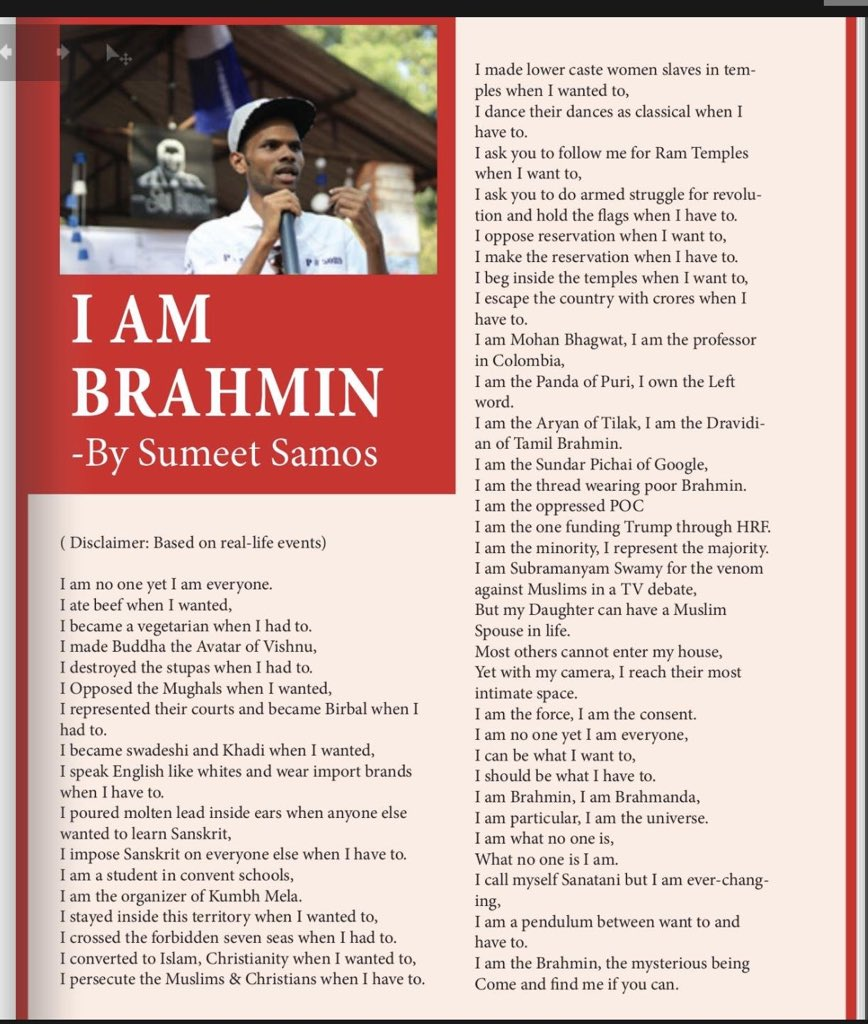
via Dilip Mandal on Twitter 

Inline image

Reply all
Reply to author
Forward
0 new messages